Oscilloscope
Senoir Capstone
Fall 2025
This project investigates how rhythm influences psychological states and perceptual experience, and translates those findings into a motion-graphics, driven visual system. Drawing from psychology and neuroscience, the research examines how rhythmic patterns affect attention, emotional regulation, and neural entrainment, and how the brain synchronizes with external rhythmic cues. These insights are then applied through the lens of motion design, using timing, repetition, pacing, and visual rhythm to create animated compositions that embody and communicate these psychological effects.
Oscilloscope
Senoir Capstone
Fall 2025
This project investigates how rhythm influences psychological states and perceptual experience, and translates those findings into a motion-graphics, driven visual system. Drawing from psychology and neuroscience, the research examines how rhythmic patterns affect attention, emotional regulation, and neural entrainment, and how the brain synchronizes with external rhythmic cues. These insights are then applied through the lens of motion design, using timing, repetition, pacing, and visual rhythm to create animated compositions that embody and communicate these psychological effects.
Experience 1 : Beta
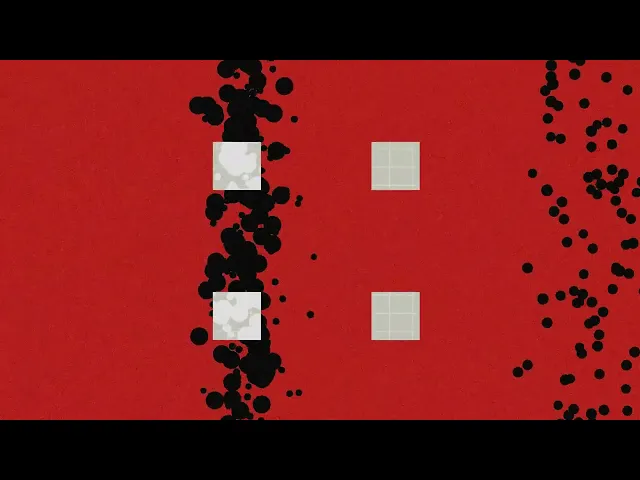
This experience focuses on Beta waves in the brain, which occur around the frequency range of 12 to 35 Hertz, and are associated with feelings of alertness and concentration. Picking up speed, this song's tempo is 135 bpm, guiding brain waves into faster oscillations. This tracks’ structure is rhythmically dense yet it provides a clear pulse for the ear to follow. It features bold and hard hitting percussive sounds that draw attention, while not taking too much focus away from the visuals. This beat moves with predictability, allowing the brain's oscillations to synchronize, while also bringing in new elements in order to challenge predictive coding and generate more interest. The track features a breakdown in the middle as well, tearing parts of the rhythm away and then allowing them to build back up. This effect creates anticipation and makes the beat more satisfying when it finally returns. The visuals are geometric but lively, maintaining organization while staying playful. They feature simple but bold colors such as apple red, jet black and a light tan to contrast them against. The shapes are angular, and jolt around the frame quickly but systematically. Moving in a way that compliments the accents of the beat, the visuals aim to enact audio-visual modulation by synchronizing and syncopating the auditory and visual elements. This piece was made with the intention of referencing the excitement of old arcade games. Emulating movement patterns like a ship rocketing through space, this video attempts to increase attention and energy.
Experience 2: Alpha
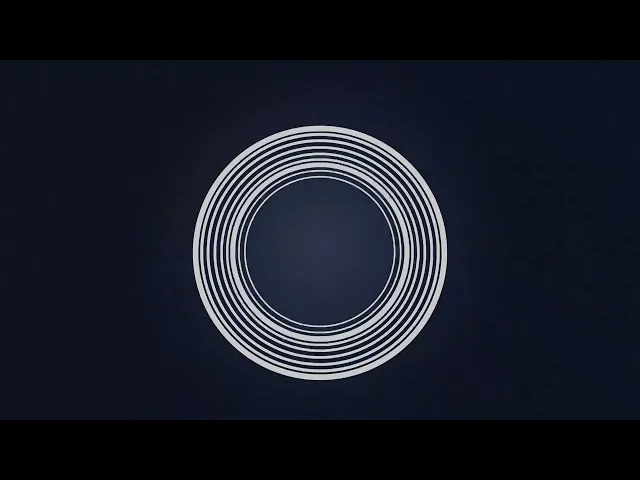
This experience focuses on Alpha waves in the brain, which occur around the frequency range of 8 to 12 Hertz, and are associated with feelings of relaxation. At 85 bpm this song is the slowest of the three, encouraging brain waves to slow down as a result. The song's rhythmic structure sways back and forth in a hypnotic, yet gentle, way. New elements are introduced to maintain interest, while making sure to not overcrowd. The percussion and synths are soft on the ears, as some sounds echo in the background to give the experience a spacious feel. The beat is immediately consistent and predictable in order for the brain to easily lock in its neural oscillations. The visuals are hypnotic as well, utilizing circles and constantly morphing shapes that move with the rhythm. The minimal colors used, such as deep and baby blues, aim to promote relaxation, with bits of light pink mixed in to add warmth and bring some contrast to the darker colors. The shapes are rounded and unthreatening as they flow smoothly across the frame. In order to conjure a peaceful atmosphere, this piece was made with the intention of referencing things like water droplets in a pond or bubbles rising from the deep sea.
Experience 3: Gamma
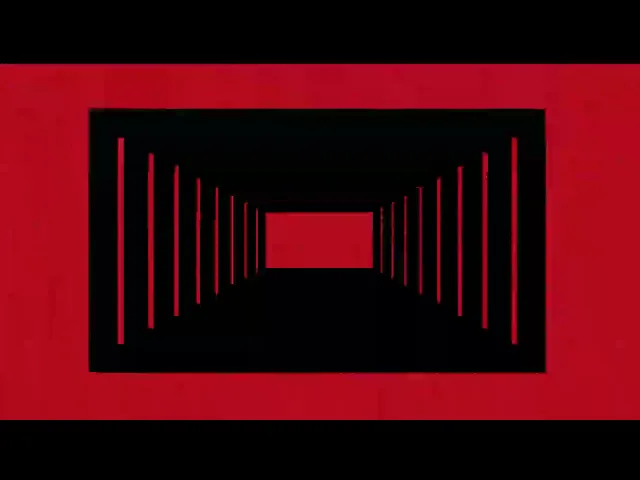
This experience focuses on Gamma waves in the brain which occur above the frequency range of 35 Hertz and are associated with feelings of high focus. However, in other contexts gamma waves are also associated with anxiety and overstimulation. Research in predictive coding finds that rhythmic inconsistencies can cause cognitive strain and induces stress in listeners. When rhythm lacks clear structure, neural oscillations in the brain become unsynchronized, as it tries to constantly adjust. The fastest track of the three, this track's tempo is 180 bpm, pushing the upper limits of what most brains are capable of processing. The rhythmic structure of this track adds to the stress created by the high tempo. It features abrupt time signatures changes like 4/4 to 5/4 and 3/4 to 4/4 causing disorientation and confusion. Heavy repetitive rhythmic elements are layered across the track, such as four on the floor kicks and snares playing in unison or stacked instruments that audibly clash with each other, making the track overwhelming. Interjections are also inserted suddenly in multiple places to break the pre-established flow, giving the listener whiplash. The visuals match this harsh energy by using jagged shapes and jarring colors. Elements that spin, strobe and jerk around the frame complement the unpredictable nature of the rhythm. Predictable rhythms reduce cognitive load and support episodic memory (remembering events) by giving the brain anchors to organize information. This experience directly challenges this neural framework by overloading the brain with stimulus that is constantly changing. All of this is crafted with the intention of creating an atmosphere of uncertainty and anxiety.
Process
Thesis
"Through motion graphics that translate rhythmic patterns into visual movement, this project investigates how synchronized audio-visual experiences can enhance rhythm’s natural ability to regulate psychological states, creating new possibilities for accessible, design-based wellness tools."
Intro
There is a gap between scientific knowledge about how rhythm influences psychological states and the ways designers translate that knowledge into visual communication. While neuroscience and psychology offer insights into how rhythm affects calmness, energy, and tension, these ideas are rarely made accessible or visually interpretable. This project addresses that gap by transforming research on rhythm and the brain into an audio-visual system that helps viewers, and designers, better understand these interactions and apply them in meaningful, informed ways.
Background
I have played drums since I was a kid and when I discovered edm and electronic music in highschool I was obsessed. I never quite understood music theory and chords but always had a great appreciation when it came to rhythm. Music is a huge part of my life and it has become more than something I use for enjoyment. I use music to help me focus on school work, to help me relax after a stressful day and even to help me gain confidence when facing an intimidating task or event. I wanted to understand how rhythm worked to influence these mental states and how I might be able to use visuals to greater display their effects. Before starting this project, I was under the assumption that the emotions produced by music originated from the melody. However, this project has revealed that even melody is part of rhythm. For this project I wanted to investigate how we perceive and physically respond to rhythm, particularly through percussion.
What is an Oscilloscope?
An oscilloscope is an electrical instrument used to visually display voltages from one or more electrical signals over time. The displayed waveform can then be analyzed for properties such as amplitude, frequency, time interval, distortion, and other things. However, musicians have found a way to use an oscilloscope to draw images and display sound. By feeding the left audio channel and right audio channel into the Xcap and Ycap inputs respectfully, the oscilloscope can map the sounds over time based on their frequency and amplitude. This allows us to take an abstract concept, like sound, and produce visuals based on math and scientific processes. I had been fascinated by this idea of hijacking the meaning and intention of a purely scientific tool like an oscilloscope in order to create art. I found this process very intriguing and it eventually became the inspiration for my capstone. “Oscilloscope” serves as a metaphor for the idea of extracting scientific data from music in order to develop a direct visual representation.
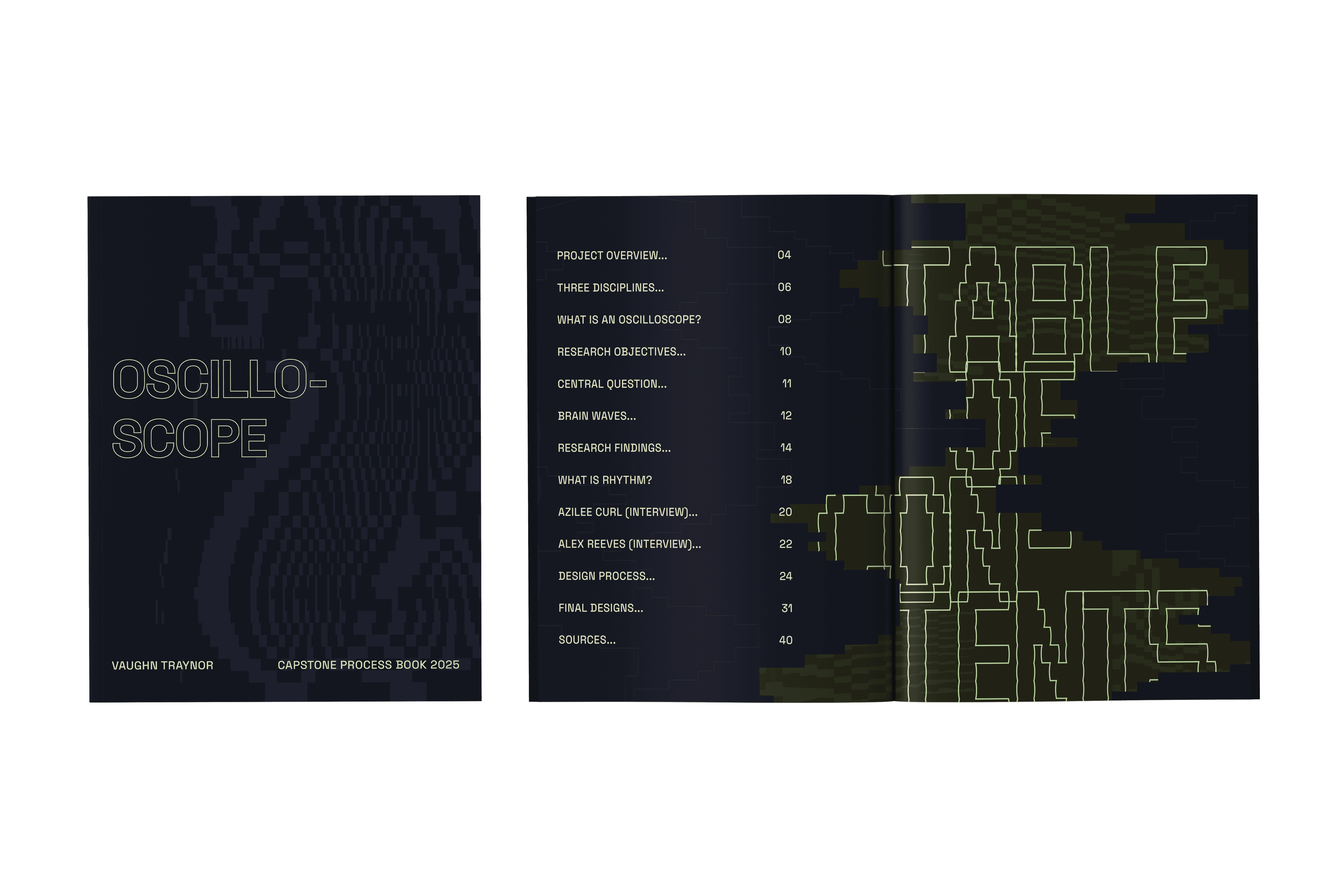
Process book
VIEW HERE
Experience 1 : Beta
This experience focuses on Beta waves in the brain, which occur around the frequency range of 12 to 35 Hertz, and are associated with feelings of alertness and concentration. Picking up speed, this song's tempo is 135 bpm, guiding brain waves into faster oscillations. This tracks’ structure is rhythmically dense yet it provides a clear pulse for the ear to follow. It features bold and hard hitting percussive sounds that draw attention, while not taking too much focus away from the visuals. This beat moves with predictability, allowing the brain's oscillations to synchronize, while also bringing in new elements in order to challenge predictive coding and generate more interest. The track features a breakdown in the middle as well, tearing parts of the rhythm away and then allowing them to build back up. This effect creates anticipation and makes the beat more satisfying when it finally returns. The visuals are geometric but lively, maintaining organization while staying playful. They feature simple but bold colors such as apple red, jet black and a light tan to contrast them against. The shapes are angular, and jolt around the frame quickly but systematically. Moving in a way that compliments the accents of the beat, the visuals aim to enact audio-visual modulation by synchronizing and syncopating the auditory and visual elements. This piece was made with the intention of referencing the excitement of old arcade games. Emulating movement patterns like a ship rocketing through space, this video attempts to increase attention and energy.
Experience 2: Alpha
This experience focuses on Alpha waves in the brain, which occur around the frequency range of 8 to 12 Hertz, and are associated with feelings of relaxation. At 85 bpm this song is the slowest of the three, encouraging brain waves to slow down as a result. The song's rhythmic structure sways back and forth in a hypnotic, yet gentle, way. New elements are introduced to maintain interest, while making sure to not overcrowd. The percussion and synths are soft on the ears, as some sounds echo in the background to give the experience a spacious feel. The beat is immediately consistent and predictable in order for the brain to easily lock in its neural oscillations. The visuals are hypnotic as well, utilizing circles and constantly morphing shapes that move with the rhythm. The minimal colors used, such as deep and baby blues, aim to promote relaxation, with bits of light pink mixed in to add warmth and bring some contrast to the darker colors. The shapes are rounded and unthreatening as they flow smoothly across the frame. In order to conjure a peaceful atmosphere, this piece was made with the intention of referencing things like water droplets in a pond or bubbles rising from the deep sea.
Experience 3: Gamma
This experience focuses on Gamma waves in the brain which occur above the frequency range of 35 Hertz and are associated with feelings of high focus. However, in other contexts gamma waves are also associated with anxiety and overstimulation. Research in predictive coding finds that rhythmic inconsistencies can cause cognitive strain and induces stress in listeners. When rhythm lacks clear structure, neural oscillations in the brain become unsynchronized, as it tries to constantly adjust. The fastest track of the three, this track's tempo is 180 bpm, pushing the upper limits of what most brains are capable of processing. The rhythmic structure of this track adds to the stress created by the high tempo. It features abrupt time signatures changes like 4/4 to 5/4 and 3/4 to 4/4 causing disorientation and confusion. Heavy repetitive rhythmic elements are layered across the track, such as four on the floor kicks and snares playing in unison or stacked instruments that audibly clash with each other, making the track overwhelming. Interjections are also inserted suddenly in multiple places to break the pre-established flow, giving the listener whiplash. The visuals match this harsh energy by using jagged shapes and jarring colors. Elements that spin, strobe and jerk around the frame complement the unpredictable nature of the rhythm. Predictable rhythms reduce cognitive load and support episodic memory (remembering events) by giving the brain anchors to organize information. This experience directly challenges this neural framework by overloading the brain with stimulus that is constantly changing. All of this is crafted with the intention of creating an atmosphere of uncertainty and anxiety.
Process
Process
Process book
Process book
Thesis
"Through motion graphics that translate rhythmic patterns into visual movement, this project investigates how synchronized audio-visual experiences can enhance rhythm’s natural ability to regulate psychological states, creating new possibilities for accessible, design-based wellness tools."
Intro
There is a gap between scientific knowledge about how rhythm influences psychological states and the ways designers translate that knowledge into visual communication. While neuroscience and psychology offer insights into how rhythm affects calmness, energy, and tension, these ideas are rarely made accessible or visually interpretable. This project addresses that gap by transforming research on rhythm and the brain into an audio-visual system that helps viewers, and designers, better understand these interactions and apply them in meaningful, informed ways.
Background
I have played drums since I was a kid and when I discovered edm and electronic music in highschool I was obsessed. I never quite understood music theory and chords but always had a great appreciation when it came to rhythm. Music is a huge part of my life and it has become more than something I use for enjoyment. I use music to help me focus on school work, to help me relax after a stressful day and even to help me gain confidence when facing an intimidating task or event. I wanted to understand how rhythm worked to influence these mental states and how I might be able to use visuals to greater display their effects. Before starting this project, I was under the assumption that the emotions produced by music originated from the melody. However, this project has revealed that even melody is part of rhythm. For this project I wanted to investigate how we perceive and physically respond to rhythm, particularly through percussion.
What is an Oscilloscope?
An oscilloscope is an electrical instrument used to visually display voltages from one or more electrical signals over time. The displayed waveform can then be analyzed for properties such as amplitude, frequency, time interval, distortion, and other things. However, musicians have found a way to use an oscilloscope to draw images and display sound. By feeding the left audio channel and right audio channel into the Xcap and Ycap inputs respectfully, the oscilloscope can map the sounds over time based on their frequency and amplitude. This allows us to take an abstract concept, like sound, and produce visuals based on math and scientific processes. I had been fascinated by this idea of hijacking the meaning and intention of a purely scientific tool like an oscilloscope in order to create art. I found this process very intriguing and it eventually became the inspiration for my capstone. “Oscilloscope” serves as a metaphor for the idea of extracting scientific data from music in order to develop a direct visual representation.